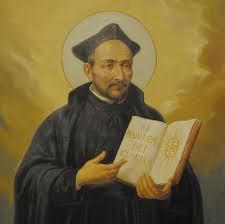
Reflecting of Veteran's Day, I realized that there is another saint that veterans could adopt as a patron saint. And that would be Saint Ignatius of Loyola, born in 1491, died July 31, 1556. A Basque knight, he had fought in many battles, the last being the defense of a castle against an invading French force. He was seriously wounded, when a cannonball shattered one of his legs. His French opponents, impressed by his valor, escorted him back to his family's castle. He recovered, but his leg never healed properly, and for the rest of his life, he would be walking with a limp.
While recuperating, Ignatius began to read books on the life of Jesus Christ, and of Catholic saints. Inspired by what he read, he set out to change his life, and to follow the Gospel of Jesus Christ. As he began to have deeper spiritual experiences, he wrote out how he came to these experiences, and these writings formed the basis for his Spiritual Exercises. He guided his university companions through these Exercises, and together they would form the Society of Jesus, also known as the Jesuits.
In the last year of his life, Saint Anthony of Padua had a tree house built in a walnut tree, to use as a hermitage, a place of prayer and contemplation. These are reflections coming from my contemplating God's world as a Secular Franciscan.
Showing posts with label Patron Saint. Show all posts
Tuesday, November 13, 2012
Friday, November 11, 2011
Veterans Day. Another Patron Saint For Veterans
(For Veterans Day, here is a revised posting from 2009.)
There is a tradition in the Catholic Church to designate a saint as a patron for certain occupations, groups, or movements. St. Francis of Assisi has been designated as the patron saint of Italy, Catholic Action, animals, and the environment. A patron saint is considered a special intercessor before God for an either group of people with a specific profession, illness and who work for special causes. I would like to make the suggestion that St. Francis be considered the patron saint of veterans who suffer from Post Traumatic Stress Disorder (PTSD).
Now I say this because Francis was not always the little holy friar, constantly in prayer, communing with the birds and the animals. In his younger days, he was an active, wealthy, young buck; the leader of the Assisi party scene, who longed to be a part of the nobility. Now for a commoner to move into those circles, he had to be knighted. To be knighted, he had to perform some great military service for a local lord. In medieval Italy, it was not hard to find some little war, somewhere. As it turned out, Francis' home town of Assisi was going to war with their neighbors, the city of Perugia. So Francis had his father spring for armor and weapons, and he joined the other Assisian men of arms as they marched on Perugia. The two armies met at a bridge and a battle ensued. Now in those days, soldiers fought each other with spears, swords, axes and daggers. It was close, in your face, combat. One survived by chopping off an opponents' limbs or gutting him. Blood and gore would have been everywhere. Long story short, the Perugians whipped the men of Assisi butts. Those who survived were either scattered or captured. The captured commoners were sent to hard labor for Perugia, the nobles were cast into dungeons, to await their families ransoming them. Because Francis was so well decked out, he was considered to be a noble and was incarcerated with the others.
Now the dungeons were dark, damp, with little water or food. It is reported that Francis tried to keep his companions' spirits up by singing songs made famous by French troubadours. But eventually, even he was worn down by the long captivity. Finally, his family was able to pay his ransom, and he was released. Francis was bedridden for a long time with illness when he got back to Assisi. When he recovered, he was able to go out once again amongst the hills and valleys of Umbrian countryside. But nature's beauty no longer touched him. Parties no longer brought joy to his heart. Feeling empty, he began turning to God for help. He would spend more time in prayer, seeking out caves for solitude. As he opened himself more to the Father's presence, he began to experience God's love for him, and the peace that comes with it. It was the beginning of his conversion.
In his book, "My Life with the Saints," Father James Martin, SJ, writes: "My novice director told me that he thought of the saints as older brothers and sisters to whom one could look for advice and counsel." I would like to think that veterans can see in Francis, somebody they can identify with, and someone they can turn to for help and encouragement.
Now I say this because Francis was not always the little holy friar, constantly in prayer, communing with the birds and the animals. In his younger days, he was an active, wealthy, young buck; the leader of the Assisi party scene, who longed to be a part of the nobility. Now for a commoner to move into those circles, he had to be knighted. To be knighted, he had to perform some great military service for a local lord. In medieval Italy, it was not hard to find some little war, somewhere. As it turned out, Francis' home town of Assisi was going to war with their neighbors, the city of Perugia. So Francis had his father spring for armor and weapons, and he joined the other Assisian men of arms as they marched on Perugia. The two armies met at a bridge and a battle ensued. Now in those days, soldiers fought each other with spears, swords, axes and daggers. It was close, in your face, combat. One survived by chopping off an opponents' limbs or gutting him. Blood and gore would have been everywhere. Long story short, the Perugians whipped the men of Assisi butts. Those who survived were either scattered or captured. The captured commoners were sent to hard labor for Perugia, the nobles were cast into dungeons, to await their families ransoming them. Because Francis was so well decked out, he was considered to be a noble and was incarcerated with the others.
Now the dungeons were dark, damp, with little water or food. It is reported that Francis tried to keep his companions' spirits up by singing songs made famous by French troubadours. But eventually, even he was worn down by the long captivity. Finally, his family was able to pay his ransom, and he was released. Francis was bedridden for a long time with illness when he got back to Assisi. When he recovered, he was able to go out once again amongst the hills and valleys of Umbrian countryside. But nature's beauty no longer touched him. Parties no longer brought joy to his heart. Feeling empty, he began turning to God for help. He would spend more time in prayer, seeking out caves for solitude. As he opened himself more to the Father's presence, he began to experience God's love for him, and the peace that comes with it. It was the beginning of his conversion.
In his book, "My Life with the Saints," Father James Martin, SJ, writes: "My novice director told me that he thought of the saints as older brothers and sisters to whom one could look for advice and counsel." I would like to think that veterans can see in Francis, somebody they can identify with, and someone they can turn to for help and encouragement.
Labels:
Francis of Assisi,
Patron Saint,
Veterans Day
Monday, October 5, 2009
Suggestion for a Patron Saint of Veterans

Yesterday, October 4th, was the feast day of St. Francis of Assisi. Now St. Francis has been designated as the patron saint of Italy, Catholic Action, animals, and the environment. A patron saint is considered a special intercessor before God for an either group of people with a specific profession, illness and who work for special causes. I would like to make the suggestion that St. Francis be considered the patron saint of veterans who suffer from Post Traumatic Stress Disorder (PTSD).
Now I say this because Francis was not always the little holy friar, constantly in prayer, communing with the birds and the animals. In his younger days, he was an active, wealthy, young buck; the leader of the Assisi party scene, who longed to be a part of the nobility. Now for a commoner to move into those circles, he had to be knighted. To be knighted, he had to perform some great military service for a local lord. In medieval Italy, it was not hard to find some little war, somewhere. As it turned out, Francis’ home town of Assisi was going to war with their neighbors, the city of Perugia. So Francis had his father spring for armor and weapons, and he joined the other Assisian men of arms as they marched on Perugia. The two armies met at a bridge and a battle ensued. Now in those days, soldiers fought each other with spears, swords, axes and daggers. It was close, in your face, combat. One survived by chopping off an opponents' limbs or gutting him. Blood and gore would have been everywhere. Long story short, the Perugians whipped the men of Assisi butts. Those who survived were either scattered or captured. The captured commoners were sent to hard labor for Perugia, the nobles were cast into dungeons, to await their families ransoming them. Because Francis was so well decked out, he was considered to be a noble and was incarcerated with the others.
Now the dungeons were dark, damp, with little water or food. It is reported that Francis tried to keep his companions’ spirits up by singing songs made famous by French troubadours. But eventually, even he was worn down by the long captivity. Finally, his family was able to pay his ransom, and he was released. Francis was bedridden for a long time with illness when he got back to Assisi. When he recovered, he was able to go out once again amongst the hills and valleys of Umbrian countryside. But nature’s beauty no longer touched him. Parties no longer brought joy to his heart. Feeling empty, he began turning to God for help. He would spend more time in prayer, seeking out caves for solitude. As he opened himself more to the Father’s presence, he began to experience God’s love for him, and the peace that comes with it. It was the beginning of his conversion.
In his book, “My Life with the Saints,” Father James Martin, SJ, writes: “My novice director told me that he thought of the saints as older brothers and sisters to whom one could look for advice and counsel.” I would like to think that veterans can see in Francis, somebody they can identify with, and someone they can turn to for help and encouragement.
Now I say this because Francis was not always the little holy friar, constantly in prayer, communing with the birds and the animals. In his younger days, he was an active, wealthy, young buck; the leader of the Assisi party scene, who longed to be a part of the nobility. Now for a commoner to move into those circles, he had to be knighted. To be knighted, he had to perform some great military service for a local lord. In medieval Italy, it was not hard to find some little war, somewhere. As it turned out, Francis’ home town of Assisi was going to war with their neighbors, the city of Perugia. So Francis had his father spring for armor and weapons, and he joined the other Assisian men of arms as they marched on Perugia. The two armies met at a bridge and a battle ensued. Now in those days, soldiers fought each other with spears, swords, axes and daggers. It was close, in your face, combat. One survived by chopping off an opponents' limbs or gutting him. Blood and gore would have been everywhere. Long story short, the Perugians whipped the men of Assisi butts. Those who survived were either scattered or captured. The captured commoners were sent to hard labor for Perugia, the nobles were cast into dungeons, to await their families ransoming them. Because Francis was so well decked out, he was considered to be a noble and was incarcerated with the others.
Now the dungeons were dark, damp, with little water or food. It is reported that Francis tried to keep his companions’ spirits up by singing songs made famous by French troubadours. But eventually, even he was worn down by the long captivity. Finally, his family was able to pay his ransom, and he was released. Francis was bedridden for a long time with illness when he got back to Assisi. When he recovered, he was able to go out once again amongst the hills and valleys of Umbrian countryside. But nature’s beauty no longer touched him. Parties no longer brought joy to his heart. Feeling empty, he began turning to God for help. He would spend more time in prayer, seeking out caves for solitude. As he opened himself more to the Father’s presence, he began to experience God’s love for him, and the peace that comes with it. It was the beginning of his conversion.
In his book, “My Life with the Saints,” Father James Martin, SJ, writes: “My novice director told me that he thought of the saints as older brothers and sisters to whom one could look for advice and counsel.” I would like to think that veterans can see in Francis, somebody they can identify with, and someone they can turn to for help and encouragement.
Subscribe to:
Posts (Atom)
