Thursday, December 6, 2012

Deacon Prevented From Addressing Other Deacons


The National Catholic Reporter has reported that Deacon William Ditewig was denied permission to give an address to a meeting of deacons, their wives, and deacon candidates for the Archdiocese of Philadelphia.  The Archdiocese requires speakers to be approved by a commission of archdiocesan priests and a lay theologian.  Because Deacon Ditewig; who had in the past been on the staff of the National  Conference of Catholic Bishops; is himself a theologian, and an author of numerous books on the diaconate.  He co-authored a book examining the possibility of women being ordained as deacons. 

Although he did not intend to speak about this in his address, the commission felt that still his presence would cause confusion among the faithful.

Deacon Ditewig has spoken to numerous deacon assemblies.  I have read several of his books and essays, and found them informative, inspiring, and a joy to read.  And I believe him to be a loyal son of the Church. 

Our bishops have the responsibility to protect the faithful; but over zealousness can also prevent the Spirit from working within us, stifling legitimate theological exploration, that can lead to discernment of the Father’s will for His Church.  


Sunday, December 2, 2012

First Sunday of Advent - 2012


“Be vigilant at all times and pray that you have the strength to escape the tribulations that are imminent and to stand before the Son of Man” Luke 21: 36 (From the readings of First Sunday of Advent, Cycle C)
                                                           
“Secular Franciscans, therefore, should seek to encounter the living and active person of Christ in their brothers and sisters, in Sacred Scripture, in the Church, and in liturgical activity.  The faith of Saint Francis, who often said ‘I see nothing bodily of the Most High son of God in this world except his most holy body and blood,’ should be the inspiration and pattern of their Eucharistic life.”  (Art.5, SFO Rule)

Advent should be a time of anticipation, of preparation, of remembrance.  We remember the event of the birth of our Lord Jesus Christ, the Son God coming into our world as a human child.  We prepare ourselves in expectation of His coming again at the end of time.  But Advent is also a time to prepare for and to anticipate an encounter with Christ here and now. 

Saint Francis believed that through the people he met in the streets of Assisi, through the poor and downtrodden, he encountered Christ.  In listening and meditating on the Scriptures, he encountered Christ.  And especially in receiving the Eucharist, he encountered Christ.  We see in his writings and in stories of his life, Francis lived as one who always anticipated that in the next moment he would meet Jesus Christ.  We can feel, through his words, the excited anticipation he felt.

With all that is happening with us during the mad rush to prepare for Christmas, and with all the everyday pressures and troubles we experience, it can be hard to be fully open to the same sense of anticipation that Francis had.  Yet, we should all strive to keep our hearts open in joyful expectation, because we can never know when we will encounter Jesus.

Thursday, November 22, 2012

Happy Thanksgiving To All!

Happy Thanksgiving to all my family and friends!  I thank the good Lord for the gift of all of you, especially my wife Peg, my mother, Peg's parents, and all my siblings, on both sides of the family.

It has been two months today since my ordination as a Permanent Deacon!  So I am thankful to our God, for the calling to this ministry, and the graces I need to fulfill it.


"All-powerful, all holy, most high and supreme God, sovereign good, all good, every good, you who alone are good, it is to you we must give all praise, all glory, all thanks, all honor, all blessing; ; to you we must refer all good always. Amen"          (The Praises Before the Office by St. Francis of Assisi)


Saturday, November 17, 2012

My First Homily - Thirty-Third Sunday of Ordinary Time

Readings:
Daniel 12: 1-3
Hebrews 10: 11-14, 18
Mark 13: 24-32


One of the favorite themes of science fiction writers and sci fi movies is the end of the world.  It is always shown as a series of disasters that will either wipe out all life on this planet, or totally destroy Earth itself.  On some of the science cable channels, I have seen computer generated images of the sun going supernova and destroying the planets of our solar system.  This is scary stuff, as frightening as the words we have just heard,   “…the sun will be darkened, and the moon will not give its light, and the stars will be falling from the sky, and the powers in the heavens will be shaken.”  Can you imagine how these words may have affected early Christians, or the people of the Middle Ages, in those times before our modern understanding of how the universe works.  Because now we have scientists telling us that it will be billions of years before our sun will be close to going to supernova; and unknown billions of years before the universe ceases to exist.  So barring some cosmic accident, or some catastrophic natural event, we can all take it easy.  Right?  Well there is that last statement that Jesus makes in today’s Gospel, “But of that day or hour, no one knows, neither the angels in heaven, nor the Son, but only the Father.”
Now why make this statement?  I would suggest that Jesus does not want His followers to be too complacent about how we are or are not living the Gospel life.  And this is a constant theme throughout the Scriptures, we must all live in expectation that the Risen Lord will come again into our world; and His coming will forever change our lives.  His coming will be awesome!  We see this theme of constant expectation in the Old Testament, with the early Israelites, on the night of Passover, they were dressed to move, and they are eating the Passover meal in expectation that something awesome was going to happen in the morning.  And it does, the Lord comes and frees His people.  In today’s first reading, we see the prophet Daniel, speaking words of encouragement to the Jewish people, whose lands are occupied, the people scattered and under religious persecution.  And Daniel is telling the nation, to be ready, for as bad as the times are, the Lord, through his angel Michael, is coming.  Something is about to happen, something wonderful, something glorious, something awesome!
So Jesus, in Mark’s Gospel, is telling us, be ready, for the risen Christ is going to return to us, and His coming is not to be feared, but to be look forward to, because His coming is going to be awesome! 
And how are we to make ourselves ready for His coming?  I would suggest that we try to live our lives in constant expectation of encountering Christ in our daily lives.  When we wake up in the morning, we awaken with the expectation that throughout the day, we will encounter Christ.  We walk out into the world and see God’s hand in His creation.  In every person we meet during the day, whether rich or poor, we may encounter Christ in that person.  When we engage in daily prayer and reading Scripture, we open our minds and hearts to Christ.  And now, in this place, we are gathered here around this altar, where in a short while, simple bread and wine will be transformed into the Body and Blood of Christ, We will come forward in expectation of receiving Him, and becoming one with Him, and that will be awesome!


Tuesday, November 13, 2012

Another Saint For Veterans

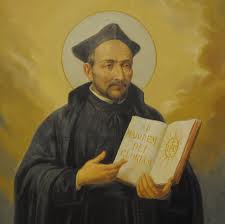
Reflecting of Veteran's Day, I realized that there is another saint that veterans could adopt as a patron saint.  And that would be Saint Ignatius of Loyola, born in 1491, died July 31, 1556.  A Basque knight, he had fought in many battles, the last being the defense of a castle against an invading French force.  He was seriously wounded, when a cannonball shattered one of his legs.  His French opponents, impressed by his valor, escorted him back to his family's castle.  He recovered, but his leg never healed properly, and for the rest of his life, he would be walking with a limp. 

While recuperating, Ignatius began to read books on the life of Jesus Christ, and of Catholic saints.  Inspired by what he read, he set out to change his life, and to follow the Gospel of Jesus Christ.  As he began to have deeper spiritual experiences, he wrote out how he came to these experiences, and these writings formed the basis for his Spiritual Exercises.  He guided his university companions through these Exercises, and together they would form the Society of Jesus, also known as the Jesuits.

Tuesday, October 23, 2012

A Singing Friar

Today I was listening to the BBC Radio arts and culture program, The Strand, when I heard this story about a Franciscan friar who is gaining fame as a tenor singer.  His name is Friar Alessandro Brustenghi.  The British newspaper, the Telegraph.also wrote a story about this talented friar in May.  He has signed a record deal with Decca Records, with his cut of the sales proceeds to go to the Franciscan Order.  Keep your eyes and ears open for this CD.

Thursday, October 4, 2012

Feast of St. Francis of Assisi - October 4th

Today was the Feast of Saint Francis of Assisi.  Following is a 2007 column I wrote about St. Francis for my Secular Franciscan fraternity.


“The rule and life of the Secular Franciscans is this:  to observe the gospel of our Lord Jesus Christ by following the example of Saint Francis of Assisi, who made Christ the inspiration and the center of his life with God and people.”  (Art. 4, SFO Rule)

A story in The Little Flowers of St. Francis of Assisi has Brother Masseo asking St. Francis, “Say, why it is that all the world comes after you, and everybody desires to see you, and to hear you, and to obey you?”  Almost 800 years later, the question still has relevance.  Why is it that the world is still attracted to the figure of St. Francis?  For many, they attracted to the image of St. Francis, the man who was connected to nature, to whom animals and birds came to readily.  For others, it is the image of Francis, the servant of the poor, the forgotten.  And there are those who see in Francis, a perfect person of prayer and contemplation.

Why are we attracted to this little poor man of Assisi?  For me, Francis shows me how an ordinary person can live the Gospel of Jesus Christ, by being a person of prayer, by giving up those things that distract me from loving God, and emptying myself in the service of others.  Francis provides the inspiration for me, and for many others, to find the path that Jesus wishes each of us to take to the Kingdom.

We can all still learn from Francis what it means to live the Gospel life.  It means that we need to learn more about him, read and reflect on his words.  Each of us should try to read the early biographies of his life, written by authors who were still close to him or to those who knew him.  Feel the excitement and the power of his presence that those early biographers felt, and open our hearts and our minds to feel it also.  Then we will come to know the answer to Brother Masseo’s question, “Why after you?”